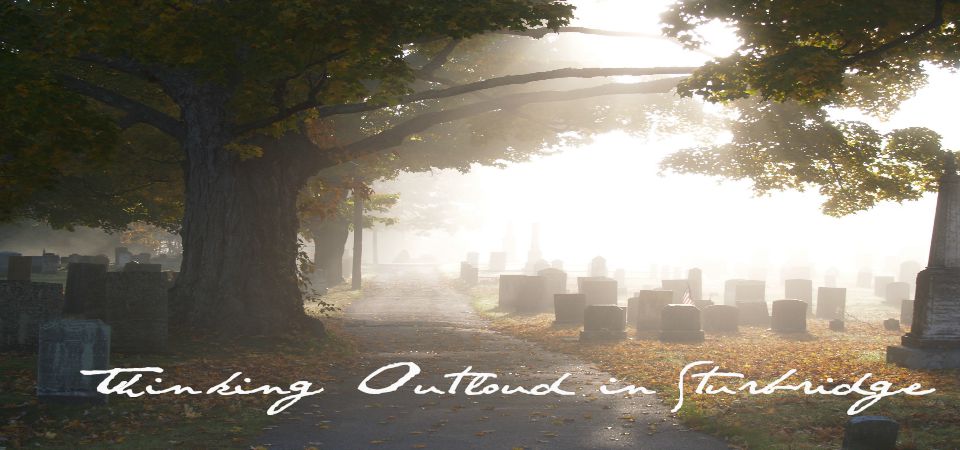
Autumn in the North Cemetery.

Sixty miles west of Boston, Massachusetts there is the small New England town of Sturbridge. Located at the junction of I-90 (The Mass Pike), and I-84 it has become known as the "Crossroads of New England". The town was first settled over 300 years ago, and like other small New England towns it has grown just enough over the years to be in a difficult place today. How do we embrace the future without forgetting how we got to our present? How do we attract the right kind of growth, and maintain who we are? And, what about our culture out here in Central Massachusetts?


These pages will cause one to think about how to protect what we have, our future direction, and how to move on in the very best way.


Those thoughts, and other ramblings, will hopefully inspire more thought, conversation, action, and occasionally a smile...

...seems to be working so far

Tuesday, October 7, 2008

Learn To See

Put your camera in your car. OK, not right this second, but when you're done reading get out of the chair, grab the camera and go stick it in your car on the passenger seat. The next time you are out and about town it will be waiting for you to take a photo.

Of what? Well, it's fall. Take a picture of anything. Having the camera waiting beside you is one way to learn to see, and not just look. If you know it's there to take a photograph you'll soon learn to see good photos long before you put them in your camera. Things you ride by everyday, and not think twice about, you see in a different way. Everyday things. Random things. Even the most common views somehow are seen differently as the light changes throughout the day. Watch for it. Notice it. Then take a picture.

After a fifty or so photos you will begin to notice something: those places, and things you looked at everyday as you walked, or drove by them, are different. You begin to see the afternoon light touching them and casting a shadow down one side. The color of objects will take on different hues as the light changes during the day. The same object can look totally different at 4:00 PM than when when you saw it 11:00 in the morning. You start to analyze the scene. Compose the shot better, and in a short time, your photographs will start to look like masterpieces.

It's strange how we may know that the light changes throughout the day, but may not have been able to actually use it for something creative before. Just having the camera beside you, and not even putting it to your eye, opens a part of your brain you probably haven't used very often before. A creative place, and once you open up that creative right side of your brain more often, for some reason the black and white things coming from the left side are analyzed easier, and understood better.

Don't know why, just happens.


"How is the Right Brain / Left Brain Concept Relevant to Artists? When you start a painting, you need be able to to visualise the final painting in your mind (right brain, working from the whole), then develop the painting, choosing the elements, matching and mixing colours, placing in the shadows and highlights (right brain, working on various things simultaneously), but at the same time be able to look critically at what you've doing (left brain, being analytical). By finding out whether your thinking is dominated by your right or left brain, you can then deliberately set out to use the 'right brain' way of thinking in your painting or drawing, rather than working on 'auto-pilot'. By trying a different strategy you will probably be surprised by what different results you can produce." Source


Something so simple, yet it accomplishes so much. You'll start to actually "see" instead of just look, and you will critique your work and improve in a short time. When both sides of the brain are working in harmony you will begin to see, and analyze other things like problems, issues, and opinions in a different way as well.

And, as an added bonus, you will also have some great photographs to hang on your wall.

Thursday, October 2, 2008

This Is Great!

Dear Town of Sturbridge residents, employees and friends,

On behalf of the Grand Trunk Trail Blazers and the Town of Sturbridge Conservation Commission, I am proud to inform you that we are a finalist in the national "Save the Trails" funding program, made possible by the generous efforts of Nature Valley and American Hiking Society's National Trails Fund. Adding to this honor is the fact that we were selected from a competitive pool of 160 nonprofit applicants from across the nation. From October 1-31, you may learn about our cause and vote for us at http://www.wheresyours.com/. The top 10 finalist with the most online votes will each receive $5,000 in funding, so your vote will help us to get one step further to revitalizing the Camp Robinson Crusoe trail in Sturbridge. This money will help us to create an accessible trail on the property during summer 2009. Please pass the word along and encourage other hiking and outdoor enthusiasts to vote for us at http://www.wheresyours.com/. We hope to give a great gift to our community by revitalizing the Camp Robinson Crusoe trail - a gift that will only be possible with your vote of support. (Please see the direct link below)

Thank you in advance and happy hiking!

Very Sincerely,

Erin E. Jacque
Conservation Agent
Town of Sturbridge308 Main Street,
Town Hall
Sturbridge, MA 01566
(508) 347-2506(508) 347-5886 (fax)
ejacque@town.sturbridge.ma.us

http://www.wheresyours.com/SaveTheTrailsVote.aspx

Strange Case, Indeed

Today I had some time to catch up on some reading. Nothing too deep, mostly online things sent to me. I read a few pieces, and after reading two in particular, I could not help but think of Robert Louis Stevenson's classic story.

Strange how the mind works.

"Strange Case of Dr Jekyll and Mr Hyde
is a novella written by the Scottish author Robert Louis Stevenson and first published in 1886. It is about a London lawyer who investigates strange occurrences between his old friend, Dr Henry Jekyll, and the misanthropic Edward Hyde.

The work is known for its vivid portrayal of a split personality, split in the sense that within the same person there is both an apparently good and an evil personality each being quite distinct from each other; in mainstream culture the very phrase "Jekyll and Hyde" has come to mean a person who is vastly different in moral character from one situation to the next
.

This is different from multiple personality disorder where the different personalities do not necessarily differ in any moral sense.
"

--From Wikipedia

It's been 3 days since this was posted, and comments are now closed.

Wednesday, October 1, 2008

Something to Consider During These Hard Financial Times

"If you had purchased $1000 of shares in Delta Airlines one year ago you will have $49.00 today.If you had purchased $1000 of shares in AIG one year ago you will have $33.00 today.If you had purchased $1000 of shares in Lehman Brothers one year ago you will have $0.00 today.But if you had purchased $1000 worth of beer one year ago drank all the beer then turned in the aluminum cans for recycling refund you will have received $214.00. Based on the above the best current investment plan is to drink heavily & recycle. It is called the 401-Keg. A recent study found that the average American walks about 900 miles a year. Another
study found that Americans drink on average 22 gallons of alcohol a year.

That means that on average Americans get about 41 miles to the gallon! Makes you proud to be an American!"

--submitted by Patty in Greenville, SC

Passing Grades Are Important Throughout Life

Most of us have a job. The percentage of us that don't are either retired, or unable to work for whatever reason. If we are a single parent with a few small kids we still have a job: raising our children. In fact, even if we are retired, we still have responsibilities that others expect, and may even rely on us for. The point is, most of us have obligations to others whether it be a company, or other people, and how we perform that job will determine if we get to keep that job, or get transferred to something more our speed.

The job evaluation is an important part of grading our performance. Doesn't matter what our job is, someone other than ourselves will rate our performance. At a conventional job it is usually our immediate boss, or someone in Human Resources that hands out our annual review. That review is meant to show areas for improvement, and to acknowledge what we do well. If we are the single parent, then our review may come from relatives, or teachers, or in some cases , the Commonwealth.

Here in Central Mass even farmers have an annual review, that's what Fairs are about. Blue, red and white ribbons are awarded to those that have submitted their work for review. Red, and white ribbons are prized just as much as the ultimate blue ribbon. Those ribbons acknowledge a job well done, but also tell us that someone else has performed better. The ribbons set a goal for the farmer: to win the blue ribbon next year.

I've had my share of performance evaluations. Many have been great, and some have been, well, not so great. With some of the "not so great" evaluations I have chosen to improve, and subsequent evaluations have shown that I did. Other times, I felt I was being unfairly graded, and I wished my boss would retire, or move to Uruguay before my next one.

Performance evaluations are also a private thing. Most companies treat them as they would treat how much you earn each year. But, there are times when evaluations can be had for public consumption. Public officials are subject to this, in fact, any public employee is also subject to this. Is it a good thing?

That depends on the intent of the person obtaining the information, and how the information is ultimately used.

Let's say a small town hires a person to administrate things in the town. Let's call that person a Town Administrator for lack of a better word. Now, let's say that person performs well. Great. Give him a good evaluation, and keep him on another year. This is how the system works.

It's simple.

If that person has an off year, well then it must be addressed as the events occur obviously, but they must also be addressed in the annual review as well. After all, the person was hired to perform well for the benefit of an entire town, and if that is not going as well as it should it does need to be addressed.

But, who are the evaluators? Are they the people that hired the administrator initially? Is it a separate board? And, more importantly, if the evaluation isn't what it should be, for whatever reason, and it does get into the publics hands, should it become the fodder for discussion?

Well, it is obvious the evaluators are anyone the town assigns the responsibility to, it most often is the group that hired the person initially. The other question is not as easily answered. If the town relies on the review for continued employment in the position, then, of course, it should be reviewed, and discussed. Past evaluations should also play apart in the discussion as well. Was this year a fluke? Were the evaluators unduly prejudiced? Were the examples of poor performance addressed as they occurred, or were they ignored till the review was presented?

Those are all normal questions to ask. They come hand in hand with the position, but what should never be a part of the process is for private citizens to question the review, and accuse the reviewers of being underhanded, vengeful, and hurtful. That is, of course, unless they have substantial evidence. Real evidence, not 15 pages of time stamped, he-said, she-said BS taken from some meetings minutes, or a video transcript of a meeting that didn't go as well as you wanted. Don't infuse any part of yourself into the events. It's not about you. And, don't point the finger at the reviewers for their foibles as the reason a good evaluation was not made. Stick to facts, not opinion.

Either way, let the evidence talk.

Was a specific event reviewed accurately? Was the result of the event what the reviewers would have liked to have had occur? If it is accurate, and the reviewers did not like how it was handled, then so be it. Nothing more to say.

They are "The Boss". Doesn't matter how well things have gone in the past, it is these events, these current events that are being graded, and if they don't past muster, that's it.

Now, if you want to blame the reviewers for the other persons poor evaluation, that's like blaming your hand for falling into the pit bulls mouth after it was bit, it makes no sense.

So, here we have it, a red ribbon, instead of a blue. Instead of starting a food fight in the Vegetable Pavilion, let's use it as a lesson learned, and expect a blue ribbon next year.

That being said, let it be known that all eyes will be on this during the coming year. If performance on a particular matter is not what is expected, then it needs to be addressed then, and the issue made public, and not kept a secret till review time. And, if by some freak of chance, it is as the detractors have repeated over and over again, a Witch Hunt, then let the vegies fly! And, I'll be there to whip a few zucchinis myself.